

This article is a free excerpt from inCOMPLIANCE, ICA's bi-monthly, member exclusive magazine. To gain access to more articles like this, sign in to the Learning Hub or become a member of ICA.
Despite technological advances, effective compliance remains rooted in accurate and timely KYC data, writes Muhammad Shahid Farid.
Financial institutions today invest huge sums in sophisticated compliance technologies, many of which – whether AI, transaction-monitoring systems or customer-risk-rating models – have rapidly become essential elements of contemporary AML/CFT programmes.
And yet despite the adoption of more powerful technology, regulatory enforcement action levied at financial institutions reveals a persistent underlying weakness: deficiencies in know your customer (KYC) data.
Financial institutions typically prioritise the recalibration of transaction-monitoring scenarios, the optimisation of sanctions-screening algorithms and the introduction of AI-enabled alert adjudication. And while these iniiatives can materially improve operational efficiency, they sometimes overlook a more fundamental consideration, which is that every compliance system relies upon a common input: the quality, accuracy, completeness and timeliness of customer information collected during onboaring and maintained throughout the business relationship.
My postgraduate research examined the relationship between KYC processes and three critical compliance systems: customer risk classification systems, transaction monitoring systems and sanctions screening systems. My research found that KYC deficiencies rarely remain confined to the onboarding function. Rather, they propagate across the wider compliance ecosystem, weakening the accuracy, reliability and overall effectiveness of interconnected downstream controls.

Many financial institutions continue to regard KYC as a regulatory checklist to be completed before an account is opened. This is a perception that is increasingly outdated.
KYC: Not an onboarding exercise
Many financial institutions continue to regard KYC as a regulatory checklist to be completed before an account is opened. This is a perception that is increasingly outdated. In contemporary compliance frameworks, KYC serves as the principal data foundation upon which virtually every automated compliance assessment and decision depend.
Collectively, customer occupation, source of wealth, anticipated account activity, geographical exposure, beneficial ownership, nationality, legal structure and observed transactional behaviour determine how a customer is risk-rated and monitored throughout the business relationship. Where this information is inaccurate or incomplete, inconsistent or out of date, the resulting deficiencies spill over across interconnected compliance systems, undermining the effectiveness of downstream controls.
Poor KYC data should therefore not be regarded merely as a documentation or onboarding deficiency – it constitutes an enterprise-wide data-quality risk capable of weakening almost every node of a compliance framework.
One weak foundation, three failing controls
The relationship between KYC and compliance systems can be visualised as a simple pyramid.
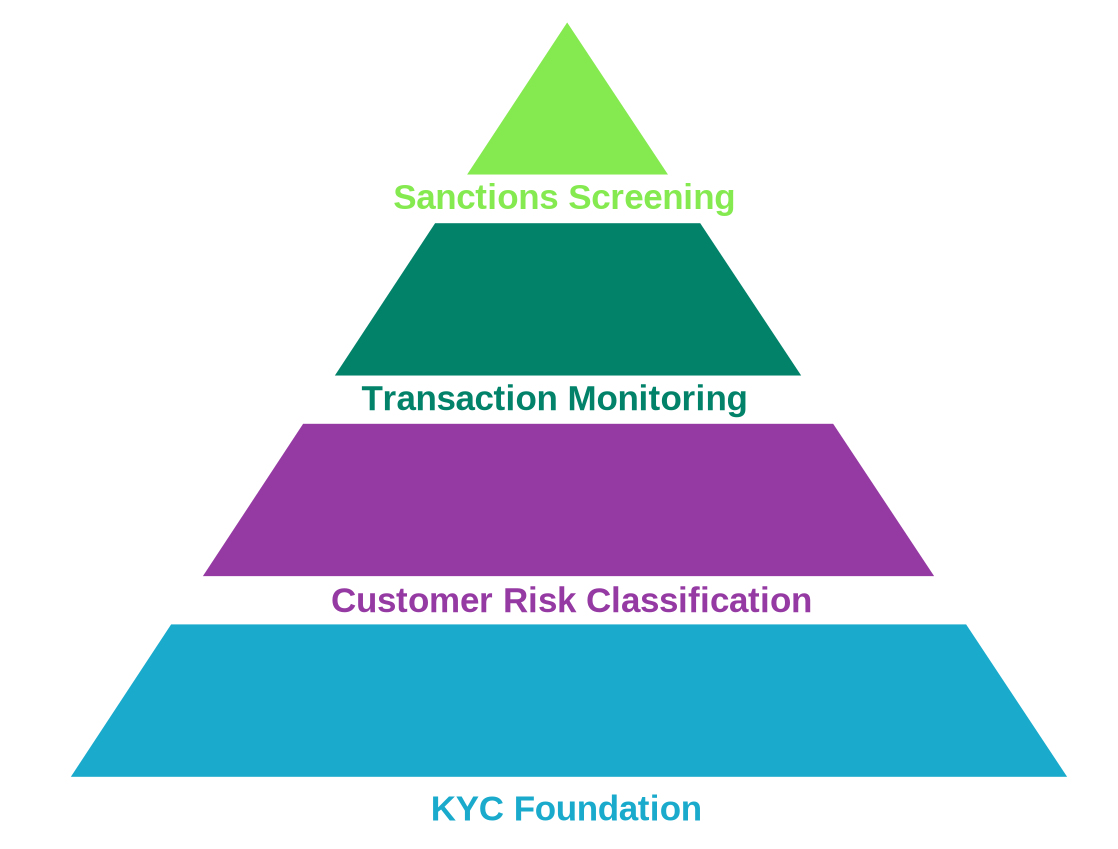
If the foundation is unstable, every layer above it becomes increasingly unreliable. It’s worth examining how this might work in practice in each of the areas resting on the KYC foundation.
Customer risk classification
Customer risk-classification models are fundamentally dependent upon the accuracy, completeness and reliability of customer information. An individual employed by a multinational corporation, for example, should not ordinarily be assigned the same risk profile as an offshore corporate vehicle operating across multiple jurisdictions.
Similarly, politically exposed persons, cash-intensive businesses and customers connected to high-risk jurisdictions warrant enhanced scrutiny due to their distinct exposure to financial-crime risks, as apposed to a person who works for an established, regulated organisation.
Where KYC information is incomplete, outdated or incorrectly recorded, financial institutions may either under-classify or over-classify customers.
Both outcomes have significant consequences. Under-classification can result in higher-risk customers being subjected to insufficient due diligence and monitoring, thereby increasing the institution’s exposure to undetected financial crime. Conversely, over-classification may generate unnecessary enhanced due diligence, excessive periodic reviews, inefficient allocation of compliance resources and increased operational costs.
Effective customer risk classification, therefore, starts not with the sophistication of the underlying algorithm, but with the integrity of the customer data upon which that algorithm relies. Even the most advanced model cannot produce reliable risk assessments from inaccurate or incomplete information.
Transaction monitoring
Often criticised for producing excessive false-positive alerts, most optimisation initiatives for transaction-monitoring systems focus on recalibrating monitoring scenarios, adjusting thresholds or introducing AI to enhance alert quality and investigative efficiency. While these measures are important, the effectiveness of transaction monitoring remains fundamentally dependent upon the quality of the customer context.
Monitoring rules and behavioural models require an accurate understanding of a customer’s expected activities. If anticipated transaction volumes are unrealistic or source-of-funds information is incomplete, the system establishes an unreliable behavioural baseline. Legitimate transactions might then be wrongly identified as suspicious, while genuinely suspicious activities may appear consistent with the customer’s inaccurately recorded profile and go undetected.
The established principle of ‘garbage in, garbage out’ remains as relevant to AI-enabled monitoring as it does to traditional rules-based systems. Regardless of its technological sophistication, no transaction-monitoring solution can adequately compensate for inaccurate, incomplete or outdated input data. Effective optimisation can only be built on robust KYC processes and reliable customer information.
Sanctions screening
Sanctions compliance is perceived by some as a sophisticated exercise in name matching. In practice, however, sanctions screening that is effective starts well before the execution of any screening algorithm. Its accuracy and reliability depend upon the extent to which the underlying customer information is consistent and complete.
Deficiencies – missing dates of birth, inaccurate nationality details, incomplete legal names, unavailable beneficial-ownership information, inconsistent transliteration, etc. – can materially impair the effectiveness of the screening.
These weaknesses give birth to two significant operational concerns. First, they generate excessive false positives, thereby increasing investigation volumes, operational costs and pressure on compliance resources. Second, and more critically, they increase the risk of false negatives, potentially allowing designated persons or entities to remain undetected.
Several international enforcement actions tell us that, far from sanctions-control failures necessarily originating in deficiencies in screening technology, they in fact frequently arise from weaknesses in customer identification, data governance and the broader control environment.
As a result, enhancing sanctions-screening effectiveness requires financial institutions to address the quality and governance of customer data alongside the configuration and performance of their screening systems.
Regardless of its technological sophistication, no transaction-monitoring solution can adequately compensate for inaccurate, incomplete or outdated input data.
AI is no panacea
With its rapid ability to significantly improve alert prioritisation and pattern recognition, as well as enhance investigator productivity, AI is increasingly regarded as the preferred solution for reducing compliance costs and enhancing operational efficiency.
The problem is that AI’s effectiveness is indelibly linked to the quality of the data from which it learns and upon which it operates.
AI does not rectify customer records that are incomplete or inconsistent. Nor does it correct inaccurate information or update that which is outdated. It merely processes defective information with greater speed and sophistication. In this sense, AI amplifies the quality of its underlying data, whether that information is right or wrong.
Financial institutions therefore risk making substantial investments in advanced technologies without first addressing the integrity of the customer information that supports them. Accordingly, improvements in data governance and KYC quality should precede, or at least accompany, the implementation of AI-enabled compliance solutions.
This relates to a broader point about connectivity. If you consider major enforcement action taken against firms like HSBC, Danske Bank and the Commonwealth Bank of Australia, an underlying pattern emerges, which is that while the underlying circumstances and control failures differed in each case, deficiencies in customer due diligence (CDD) often emerged as an early indicator of broader weaknesses in governance, risk management and regulatory compliance.
The implications for compliance professionals are clear – KYC should no longer be considered an isolated operational activity performed exclusively by the first line of defence. It should instead be recognised as an enterprise-wide control framework that supports customer risk assessment, transaction monitoring, sanctions compliance, suspicious activity reporting and regulatory reporting.
Improving KYC information strengthens not just the onboarding process but also every interconnected compliance function that relies on customer data.
Practical recommendations
Based on my research findings, financial institutions should consider implementing five practical measures.
- Reframe KYC as an enterprise-wide data-governance responsibility rather than treating it solely as an onboarding and documentation exercise.
- Adopt continuous, or perpetual, KYC processes to complement periodic customer-information reviews and respond more effectively to changes in customer circumstances and risk profiles.
- Establish board-level key risk indicators to measure and oversee the accuracy, completeness, consistency and timeliness of KYC data.
- Expand the validation of downstream compliance systems to include the quality and integrity of their KYC inputs, rather than concentrating exclusively on model design and performance.
- Ensure that AI initiatives are founded upon demonstrable improvements in data quality, recognising that sophisticated technology cannot compensate for inaccurate, incomplete or outdated customer information.
Technology is of course a crucial part on any effective control framework, and it is understandable that compliance professionals seek to enhance these frameworks through advanced transaction-monitoring systems, more intelligent sanctions-screening engines and increasingly sophisticated applications of AI. But it’s important to recognise that the most effective improvements that can be made to compliance stem from a simpler source.
The reliability of any automated compliance system depends upon the quality, accuracy and completeness of the customer information on which it operates. Technology may assist in detecting financial crime – but effective detection is possible only when supported by robust KYC processes and reliable underlying data.
As regulatory authorities increasingly assess financial institutions on the effectiveness of their AML/CFT and sanctions compliance controls, rather than merely their formal existence, firms acknowledge that a sound compliance framework does not begin with transaction monitoring or sanctions screening – it begins by establishing KYC information that is accurate, comprehensive and up-to-date.
About the author

Muhammad Shahid Farid is the MLRO Group Head of AML/CFT and Sanctions at Commercial Bank of Qatar, with more than 15 years of hands-on experience in Financial Crime Compliance. His expertise spans AML/CFT, Sanctions, Governance, Regulatory Compliance, Financial Crime Risk Assessment, and the deployment of Tech-driven Financial Crime Compliance solutions. Mr Farid holds a research-based MSc degree in Financial Crime and Compliance from the University of Manchester and several internationally recognised qualifictions, including Advanced CAMS-Audit, CAMS, CFE, CSS, CGSS, CISI-Investment Operational Certificate, and the ICA Postgradutate Diploma in Financial Crime Compliance. He is a passionate compliance professional and committed to strengthening financial integrity through research, effective governance, innovation, and proactive engagement with regulators and industry stakeholders.