


This article is a free excerpt from inCOMPLIANCE, ICA's bi-monthly, member exclusive magazine. To gain access to more articles like this, sign in to the Learning Hub or become a member of ICA.
Innovation is about creating value responsibly, which means that compliance should be involved from the outset, argues Natalie Turner
There is a moment that occurs in organisations more often than we’d readily admit. A new idea has gathered momentum and senior leaders are interested. A project team is eager to move. The commercial opportunity appears compelling, and there is pressure to act before someone else does. Then someone asks the difficult question – ‘what could go wrong?’ – and suddenly the atmosphere changes.
The compliance professional in the room is quickly perceived as the person applying the brakes, introducing caution into a conversation fuelled by possibility. Innovation appears to be moving in one direction, compliance in another. One reaches towards progress, the other protects against harm. That, at least, is how the relationship is often understood.
Yet I believe this is among the most persistent misconceptions prevalent in organisations today. Innovation is not the opposite of compliance – it is the discipline of creating value responsibly. That requires us to hold protection and progress together.
For more about the role of compliance in innovation, see here
Carrying ideas forward
AI is reshaping how decisions are made and how quickly they can be implemented. Cyber threats continue to evolve and financial crime is becoming more sophisticated. Regulation is shifting across jurisdictions, while geopolitical uncertainty and changing societal expectations are fermenting further complexity.
The steady, predictable state has vanished.
For practitioners, this represents a profound change in the nature of their role. There was a time when success could largely be measured by the ability to interpret regulation, maintain governance and prevent harm. Those responsibilities remain essential, but they are no longer sufficient on their own.
Increasingly, experts in the field are being asked to help organisations navigate ambiguity, contribute to strategic decisions and shape change before risk becomes embedded in the system. That requires more than technical expertise. It requires leadership.
For much of my career, I have been interested in why some organisations turn promising ideas into meaningful value while others struggle to move beyond good intentions. Over 25 years of working with leaders and teams around the world, I noticed a recurring pattern. Projects rarely failed because people lacked ideas. They failed because the organisation could not carry the idea forward.
Sometimes leaders failed to notice what was changing until the opportunity had passed, and sometimes an exciting idea garnered enthusiasm but was never investigated properly. In other cases, analysis continued for so long that commitment gradually ebbed away. Some organisations rushed into implementation before the risks had been understood or the people affected had been brought into the process. Others completed the project and moved on without pausing to learn.
The problem was not one of imagination, but leadership.
This observation eventually led me to develop The Six ‘I’s®, not simply as a framework for innovation, but as a strategic leadership system for navigating complexity and creating value responsibly.
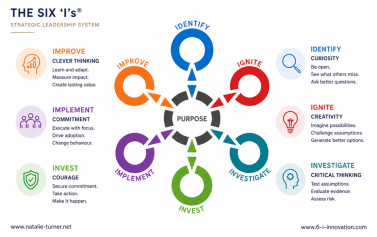
The Six ‘I’s®
Before we consider the Six ‘I’s®, we must first recognise that at its centre sits purpose. Purpose, far from being another step in a process, is in fact the reason for beginning.
Too often, organisations fall in love with a solution before they have fully understood the problem. Let’s say a new technology appears and a competitor makes a move. A senior leader becomes enthusiastic. Here, activity has begun before anyone has paused long enough to ask what value the organisation is trying to create, who will be affected, and the potential consequences that might follow.
Purpose interrupts the momentum, but it does so in order that it can ask fundamental questions: why does this matter? Whose problem are we solving? What would responsible progress look like? Without purpose, innovation can become movement without direction; with it, it becomes a more deliberate act of value creation.
Around that purpose sit six stages of innovation, each held by a corresponding leadership mindset.
Identify is powered by curiosity. It helps leaders notice change early, detect patterns and pay attention to weak signals, including emerging regulation and risks others may not yet see.
Ignite is shaped by creativity: finding more than one response when familiar solutions no longer work. In a compliance context, it means protecting the organisation without unnecessarily throwing cold water on new ideas.
Investigate calls for critical thinking. Assumptions are tested, evidence examined and opportunities weighed against risk, strengthening ideas through scrutiny rather than simply rejecting them.
Invest requires courage. This may mean influencing leaders, challenging established practice and supporting decisions without complete certainty.
Implement depends on commitment. This is where ideas move into reality and value is created, with clarity about what is changing, why it matters, what is expected and how emerging risks will be managed.
Improve is sustained by clever thinking. It requires noticing what is working, where controls create unintended effects and what must adapt as regulation, technology and behaviour evolve.
Each of these stages relies on both culture and process. Culture determines whether people feel able to question, challenge and learn together. Process provides the structure through which ideas are explored, assessed, resourced and implemented. Without both, innovation remains dependent on individual enthusiasm rather than becoming an embedded discipline.

Innovation is not the opposite of compliance – it is the discipline of creating value responsibly.
Influential leadership
Understanding leadership capability across the Six ‘I’s® also matters. Leaders bring different strengths and biases to the journey. One may remain in investigation too long; another may secure commitment but neglect improvement. The aim is not to create someone equally strong in everything, but to help leaders understand how they contribute and how different strengths can support the whole system.
These may be associated with innovation, but they are fundamentally expressions of leadership.
Compliance professionals already draw upon many of them every day. They look for what others may have missed and investigate evidence with care. They assess proportionality and ask questions that, though they may initially feel inconvenient, later prove essential. And they help organisations understand the consequences of decisions before those consequences become difficult to reverse.
What is changing today is the degree to which leaders must also influence.
Technical expertise alone is no longer sufficient, as leaders need to build trust across functions, persuade colleagues, work with ambiguity and contribute early enough to shape the direction of travel.
When compliance enters the conversation only at the end, it is forced into the role of gatekeeper. By then, positions have hardened, investment has been made and momentum has become politically difficult to challenge. When it is present earlier, something different becomes possible.
The question is no longer simply, ‘can we do this?’ but, ‘how might we do this well?’
That is a far more powerful role. It moves compliance from the edge of innovation into the heart of responsible decision-making.
One of the strongest themes to emerge from a recent conversation with the International Compliance Association was that innovation is far less about speed than many organisations assume. Sometimes the most valuable contribution a leader can make is to slow the process down, not to stop it, but to improve it. This pause before implementation allows leaders to ask what has not yet been considered, to invite perspectives that are missing and to distinguish genuine urgency from organisational impatience.
Many organisations reward speed. Far fewer reward the quality of judgement that makes speed worthwhile.
Balancing protection with progress is not a compromise between two competing priorities, but a form of leadership in its own right.
AI opportunities
AI makes this tension more acute. AI can, of course, generate possibilities, analyse information and identify patterns at extraordinary speed; it can also support preparation and expand the range of options available to decision-makers. However, crucially, what it cannot do is carry moral or organisational responsibility.
It cannot decide what matters most or understand the full weight of a decision for the people affected by it. Nor can it build trust or be held accountable.
AI may help us build the bridge faster, but human leaders must still decide where the bridge should go, who needs to cross it, determine that which lies on the other side and whether the journey should be made at all.
This is why I increasingly see innovation as a leadership discipline rather than simply a creative one.
The organisations most likely to thrive in the years ahead will not necessarily be those with the greatest number of ideas or the fastest access to technology – they will be those whose leaders know how to notice, question, decide and learn.
For those working in compliance, this creates an important opportunity. Their role is not becoming less relevant as organisations accelerate, but more central.
Compliance professionals can help organisations recognise that protection and progress are not opposing forces, and that good governance does not have to suffocate innovation. Thoughtful scrutiny can help an idea become more resilient, more trustworthy and more likely to create lasting value.
This does not mean becoming more permissive or abandoning standards. It means participating earlier, influencing more deeply, and helping the organisation move forward with its eyes open.
The practitioner in the room does not have to be the person who applies the brakes. They may instead help the organisation navigate risk and find a responsible way forward.
That is a different story about compliance. It is also a different story about innovation. At their best, both are concerned with the same question: ‘how do we create value without losing sight of what must be protected?’
Balancing protection with progress is not a compromise between two competing priorities, but a form of leadership in its own right.
And it may become one of the most important contributions the profession can make in the years ahead.
About the author

Natalie Turner is an internationally recognised author, speaker and adviser on innovation and leadership, and the creator of The Six 'I's ® Strategic Leadership System. She works with leaders, teams and organisations to strengthen their ability to navigate complexity, lead responsible change and move ideas from insight to impact. Her work helps organisations build a common language for innovation, understand leadership strengths and biases, improve collaboration and create value responsibly.