


By Muhammad Shahid Farid, 19 October 2026
For many compliance practitioners, the term ‘hawala’ still brings to mind a fairly traditional model: cash handed to a broker in one country, a message sent to a broker in another, and an equivalent amount paid to the intended recipient. No conventional international transfer necessarily takes place.
That description is still relevant, but it no longer tells the whole story.
The Financial Action Task Force’s (FATF) September 2026 report, Investigating Professional Money Laundering, Underground Banking, and the Use of Hawala and Other Similar Service Providers, paints a much more complex picture.
It describes how informal value-transfer networks increasingly intersect with bank accounts, payment service providers (PSPs), Fintech platforms, virtual assets, trade, virtual IBANs and other components of the formal financial system.
For banks and other regulated institutions, this matters because the financial institutions in question may themselves never see the hawala transaction. What they might see is only one piece of the settlement mechanism, i.e. when a natural or legal person unusually deposits cash into their account(s).
And this incomplete picture opens the door to the potential misuse of hawala and similar systems by unscrupulous actors, a concern FATF admits is a ‘widespread global phenomenon’.
Hawala itself is not crime
Hawala and similar arrangements are not in themselves criminal. They have long provided legitimate remittance and value-transfer services, particularly for migrant communities, and are especially popular in locations where access to conventional banking or PSPs is limited.
The problem is that many of the characteristics that make hawala and similar systems attractive to legitimate customers – speed, accessibility, relative low cost, flexibility, trust – are the very same characteristics that make them attractive to criminals.
The compliance challenge, therefore, is not simply to identify the use of an informal transfer mechanism. It is to distinguish legitimate activity from its exploitation for money laundering and terrorist financing purposes.
This distinction becomes particularly important when considering professional money laundering.
Professional money launderers are distinct from those criminals who simply launder the proceeds of their own crimes. They typically provide laundering services to others, often for a fee or commission. In effect, laundering becomes an outsourced business service.
A fraudster, drug trafficker or cybercriminal may therefore generate the criminal proceeds but rely on an entirely different network to collect, move, convert and eventually make that value available elsewhere.
The money does not necessarily have to move
The notion that the money in a hawala transaction does not have to move is among the most important concepts for investigators to understand.
Imagine that Person A wants to transfer the equivalent of $100,000 from Country A to Person B in Country B. Person A gives the funds to a hawala agent in Country A. That agent contacts another hawala agent of its network in Country B, who pays Person B from liquidity already available locally. At that moment, $100,000 has not necessarily travelled from Country A to Country B.
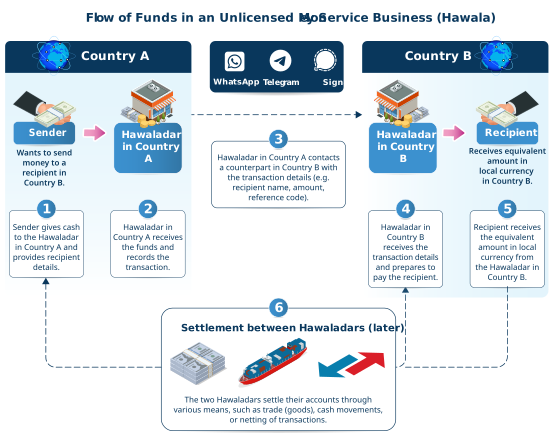
The separation between the original customer transaction and the eventual settlement is what makes these arrangements particularly challenging from an investigative perspective.
The settlement might involve another transfer moving in the opposite direction. It might involve several participants across different jurisdictions. It could be settled through trade-based money laundering, cash movement or the netting of transactions through the formal banking system, or, increasingly, through digital mechanisms.
In view of this, for an investigator looking only at the initial transaction, the full financial story may be completely obscured.
From customer to network investigation
Professional money-laundering networks may combine hawala with trade-based money laundering, shell or front companies, cash movements, virtual assets, real estate and precious metals. These should not always be viewed as isolated typologies; they may represent different components of the same laundering infrastructure.
What this means is that a broader investigative mindset is required.
Traditional AML investigations often follow a relatively linear process:
Transaction → customer → decision
A network-focused investigation should increasingly consider:
Transaction → customer → counterparties → network → controller → settlement mechanism
Link analysis can help identify relationships through common counterparties, beneficial owners, addresses, telephone numbers, devices, introducers, IP information and payment narratives. One suspicious customer may be replaceable, and so identifying the individual or network coordinating multiple accounts and businesses may be considerably more important.
When legitimate business becomes settlement infrastructure
Legitimate businesses can also become part of informal settlement structures. The risk does not arise merely because a customer operates an import/export company, deals in precious metals or runs a cash-intensive enterprise. Rather, concern arises when financial behaviour does not make economic sense in the context of the stated business.
Investigators should therefore look for combinations of indicators. These might be unexplained third-party payments, counterparties operating in unrelated sectors, the rapid movement of funds, transaction corridors inconsistent with known suppliers or customers, or significant account turnover with limited retained balances.
No single indicator necessarily establishes suspicious activity; the investigative value comes from connecting multiple indicators and understanding their economic context.
Follow the value
The broader lesson is that underground banking should not be viewed as operating entirely outside of the regulated financial system. Bank accounts, Fintech platforms, payment providers, virtual assets and legitimate businesses may all form part of the same settlement architecture.
Consequently, know-your-customer checks, customer risk assessment, transaction monitoring, sanctions screening, adverse media, fraud intelligence and external intelligence should be viewed as interconnected sources of information rather than isolated controls.
Effective financial-crime investigation must therefore progress beyond reviewing individual alerts and transactions. Investigators need to identify relationships, understand networks and controllers, establish the economic rationale behind transactions and determine how obligations are ultimately settled.
The central investigative principle is simple: follow value, not merely money. In a hawala or underground banking network, the absence of an international payment does not mean that value has not crossed a border. Sometimes, the most important transaction in an investigation is the one that never actually occurred.
Look out for Part 2 of this Insight on hawala next week, providing practical transaction monitoring scenarios to help with the detection of underground banking techniques.
About the author

Muhammad Shahid Farid is the MLRO Group Head of AML/CFT and Sanctions at Commercial Bank of Qatar, with more than 15 years of hands-on experience in Financial Crime Compliance.
His expertise spans AML/CFT, Sanctions Governance, Regulatory Compliance, Financial Crime Risk Assessment, and the deployment of tech-driven Financial Crime Compliance solutions.
Mr Farid holds a research-based MSc degree in Financial Crime and Compliance from the University of Manchester and several internationally recognised qualifications, including Advanced CAMS–Audit, CAMS, CFE, CSS, CGSS, CISI-Investment Operational Certificate, and the ICA Postgraduate Diploma in Financial Crime Compliance. He is a passionate compliance professional and committed to strengthening financial integrity through research, effective governance, innovation, and proactive engagement with regulators and industry stakeholders.